Anal Beads
 Anal Vibrators
 Butt Plugs
 Prostate Massagers
 Alien Dildos
 Realistic Dildos
 Kegel Exercisers & Balls
 Classic Vibrating Eggs
 Remote Vibrating Eggs
 Vibrating Bullets
 Bullet Vibrators
 Classic Vibrators
 Clitoral Vibrators
 G-Spot Vibrators
 Massage Wand Vibrators
 Rabbit Vibrators
 Remote Vibrators
 Pocket Stroker & Pussy Masturbators
 Vibrating Masturbators
 Cock Rings
 Penis Pumps
 Wearable Vibrators
 Blindfolds, Masks & Gags
 Bondage Kits
 Bondage Wear & Fetish Clothing
 Restraints & Handcuffs
 Sex Swings
 Ticklers, Paddles & Whips


5,000-year-old inscription reveals early Egyptian dominance
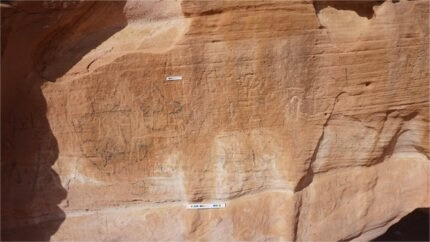
A rock art slab discovered last year in Wadi Kamila, southern Sinai, has shed new light on the origins of Egypt’s colonization of the region. The central image of the rock painting, which dates to around 3000 BC, is of a striding man with arms raised in a biceps flexion position, flanked by a kneeling man with arms tied behind his back and an arrow stuck in his chest. Behind him is a ship, a symbol of Egyptian rule.
The southwestern Sinai Peninsula contains some of the earliest images and inscriptions depicting Egypt’s military and economic control over the conquered local population. The earliest named Egyptian ruler was the Predynastic king of Upper Egypt, Iri Khor, whose name appears in the earliest known inscription of a killing scene (32nd century BC) found in the southwestern Sinai Peninsula. During the Pre/Primitive, Early Dynastic, and Old Kingdom periods, Egyptian rulers regularly sent expeditions to the region to exploit its rich resources of raw materials.
Petroglyph reliefs mentioning the success of Egyptian expeditions have previously been discovered in the Amaila Valley, Humur Valley and Maghara ruins in the southwestern Sinai Peninsula. The expert group formed last year added a fourth site to the list. It bears striking iconographic similarities to other Egyptian dominion inscriptions.
“In southwestern Sinai we can find colonization for economic purposes through images and inscriptions, some of which are more than 5,000 years old,” says Professor Ludwig Morenz, an Egyptologist at the University of Bonn. “The pattern now discovered is one of the oldest known killing scenes, accompanied by an inscription.” The terrifying Egyptian, standing in a victor’s pose before a kneeling wounded Sinai man, depicts the subjugation of the local population.
At that time, the residents of the Sinai Peninsula had no writing, no government organization, and were inferior to the Egyptians socially and culturally. The Egyptians entered the region in search of natural resources—such as the sought-after copper and gemstone turquoise—and established colonies there. “So far, the Wadi Camilla River has only been mentioned in studies related to Nabataean inscriptions, which are about 3,000 years younger than these inscriptions,” Morenz said. “There is evidence of 5,000-year-old Egyptians there that was previously unknown.”
 “In southwestern Sinai we can find colonization for economic purposes through images and inscriptions, some of which are more than 5,000 years old,” says Professor Ludwig Morenz, an Egyptologist at the University of Bonn. “The pattern now discovered is one of the oldest known killing scenes, accompanied by an inscription.” The terrifying Egyptian, standing in a victor’s pose before a kneeling wounded Sinai man, depicts the subjugation of the local population.
There is a brief inscription above the central scene of Wadi Kamila rock art. Researchers have translated this inscription as: “(Shen) Min, ruler of the copper mines/mines.” The inscription is early in the development of Egyptian hieroglyphics, so it is open to interpretation. Min is also mentioned in rock art inscriptions in the Amaila Valley. During the Primitive and Early Dynastic Periods, Ming was the god who ruled beyond the Nile Valley and was the patron deity of early Egyptian expeditions to the Sinai Peninsula. The image of a victor with arms raised may represent a god, although he lacks the characteristic attributes of that god (phallus, crown), or he may represent an Egyptian king.
The research team has published its findings in the journal abraham leaves. It can be read in pdf format here.