Anal Beads
 Anal Vibrators
 Butt Plugs
 Prostate Massagers
 Alien Dildos
 Realistic Dildos
 Kegel Exercisers & Balls
 Classic Vibrating Eggs
 Remote Vibrating Eggs
 Vibrating Bullets
 Bullet Vibrators
 Classic Vibrators
 Clitoral Vibrators
 G-Spot Vibrators
 Massage Wand Vibrators
 Rabbit Vibrators
 Remote Vibrators
 Pocket Stroker & Pussy Masturbators
 Vibrating Masturbators
 Cock Rings
 Penis Pumps
 Wearable Vibrators
 Blindfolds, Masks & Gags
 Bondage Kits
 Bondage Wear & Fetish Clothing
 Restraints & Handcuffs
 Sex Swings
 Ticklers, Paddles & Whips


Large Bronze Age Metal Host in Saxony – History

A Bronze Age hoard was found in the Klein Neundorf suburb of Klein Neundorf in eastern Germany, including 35 pounds of bronze in 310 objects. It dates back to the 9th century BC and is the largest Bronze Age holocaust ever in Upper Lusatia and the second largest holocaust in Saxony.
Bronze Age objects have been found on site since 1900, when children harvested potatoes and stumbled on three bronze daggers. Shortly after discovering, one of them was lost. The remaining two were acquired by the Görlitz Museum in 1905. A surviving couple was lost in the chaos of World War II, so in the first three daggers, only one. Two years later, the children’s father donated a socket axe to the museum.
When Görlitz Collection Director Dr. Jasper von Richthofen was in the plan to find the location for the first time in August 2023, the items have been in the museum’s collection for more than a century. This is one of the metal detectors who found the initial breakthrough on the western edge of the exploration zone. The rest of the team joined, finding more objects in the plow area. A total of 108 objects accumulated from farming activities were found.
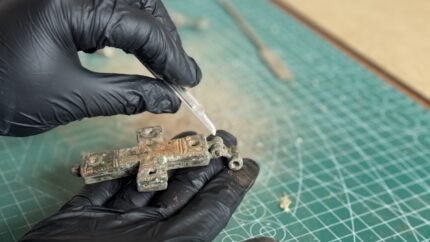
 Finally, several objects were found gathering in one place. They are the original deposited surfaces that are left when the artifacts on the top are scattered by the plow. The rest of the hoard remains intact at its burial site and was removed for excavation in the recovery laboratory of the Saxon Archaeology Office.
The excavation time is from September 2023 to the end of April 2024. Most of any object found so far is a sickle. There are 136 sickles in the hoard. Runner-up is the axis. There are 50 of them. Photogrammetry images were taken at each stage of the excavation so that a 3D model of the holocaust could be created, allowing researchers to study in their original location and relatively relative positions.
Special features include a sword split into four pieces, and a Spindlersfeld-type brooch named after a location near Berlin. Of the four fractures on the sword, two of them were old, indicating that the weapon was deposited in a ruptured state. When put together, the total length of the sword is 44 cm, making it short. The saddle consists of two metal shells, where a disc of organic material is attached, which may be bone or ivory. Further analysis will clarify this. Although the sword is unique in type, experts suspect it originated in southern Germany.
 Special features include a sword split into four pieces, and a Spindlersfeld-type brooch named after a location near Berlin. Of the four fractures on the sword, two of them were old, indicating that the weapon was deposited in a ruptured state. When put together, the total length of the sword is 44 cm, making it short. The saddle consists of two metal shells, where a disc of organic material is attached, which may be bone or ivory. Further analysis will clarify this. Although the sword is unique in type, experts suspect it originated in southern Germany.
Now all artifacts are being scientifically analyzed and conserved for future exhibitions.